Best Kitchen Essentials & Cooking Equipment - 2026 Guide
A well-stocked kitchen starts with a good chef's knife, chopping board, tongs, turner, mixing bowls, measuring tools, colander and food storage. From there, the best kitchen tools are the ones that make your most common tasks quicker or easier.
Our 2026 guide covers the everyday kitchen necessities worth buying first, the prep tools and appliances you can add later, and what you should expect to spend on each. We'll also show you where spending more makes a difference and which gadgets you can comfortably skip.

The essential kitchen tools checklist
What to buy first vs. what can wait
Buy now. The daily-use foundation:
- Chef's knife: handles most chopping, slicing and dicing. $40–$100.
- Chopping board: protects benches and the knife edge. $20–$50.
- Tongs: turning, lifting, serving and tossing. $10–$25.
- Turner/spatula: flipping and lifting without tearing. $10–$25.
- Mixing bowls: prep, marinating, batters and serving. $15–$55.
- Measuring cups and spoons: repeatable results, especially for baking. $7–$25.
- Vegetable peeler: peeling, plus ribboning and shaving. $11–$20.
- Colander or strainer: draining and rinsing. $15–$40.
- Food storage containers: leftovers, meal prep and pantry storage. $20–$75
Add later, once your cooking habits show you need them:
- Grater or zester: cheese, citrus, garlic, ginger and spices. $20–$40.
- Salad spinner: dries leaves so dressing sticks. $47–$60.
- Blender: smoothies, soups, sauces and batters. $190–$235.
- Air fryer: fast crisping and small-batch cooking. $90–$230.
- Spiraliser: vegetable noodles and ribbons. $30–$35.
The tools you'll reach for every day
Some kitchen tools get used far more often than others. These six cover most everyday prep jobs, so they're worth choosing carefully.
A chef's knife
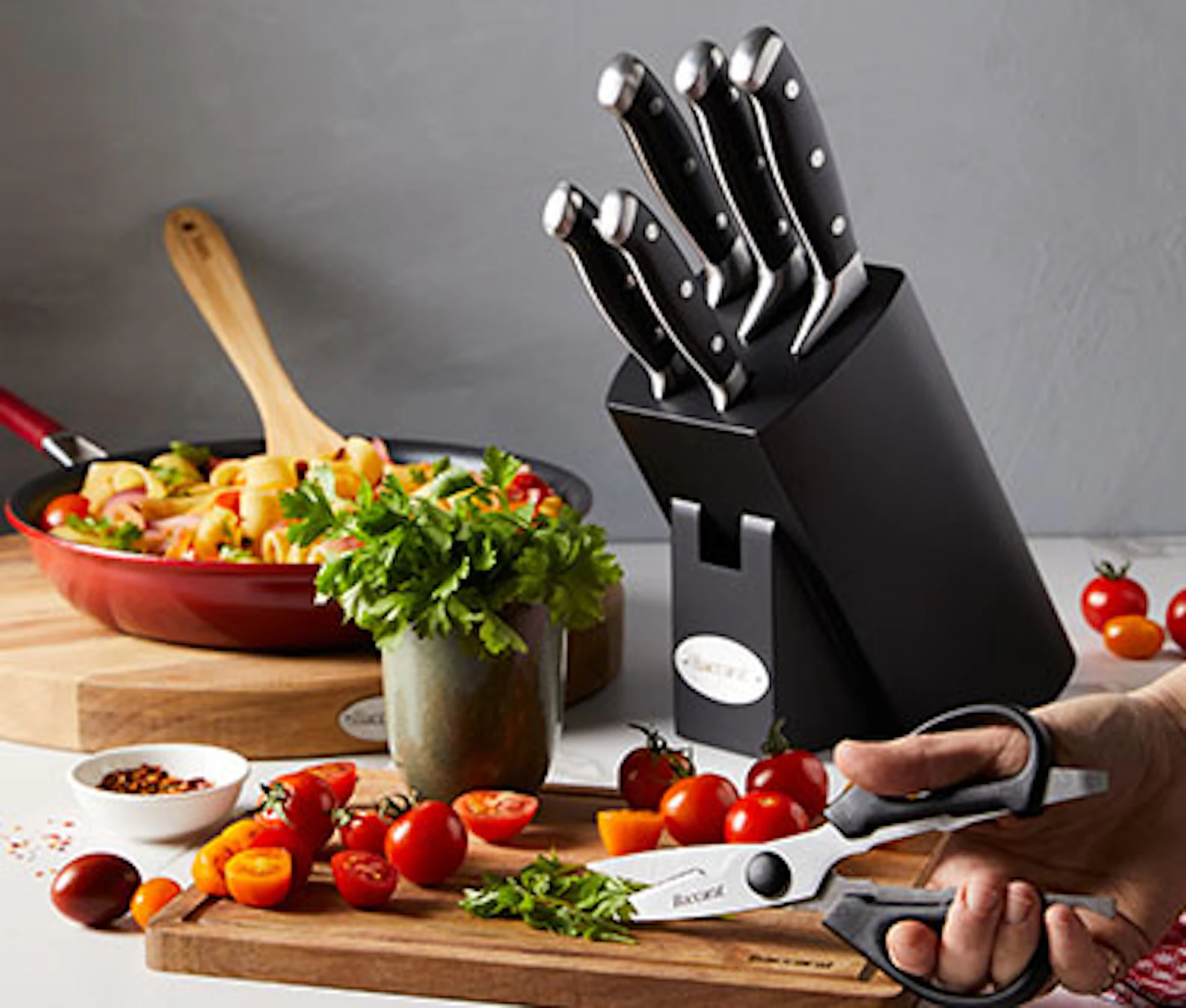
A chef's knife is the most versatile knife in the kitchen. It handles everything from chopping onions and herbs to slicing meat and dicing vegetables. If you're starting from scratch, one good chef's knife can do most of the work you'd otherwise buy a full knife block to cover.
A 20cm blade is a practical all-round size. It gives you enough length to slice larger vegetables, cuts of meat and other bulky ingredients in fewer strokes, while still being manageable for everyday chopping.
Look beyond price and focus on how the knife feels. It should sit comfortably in your hand, feel balanced rather than blade-heavy, and have a secure grip. A full-tang blade, where the steel extends through the handle, can add strength and balance, although construction alone doesn't determine how well a knife performs.
As you spend more, differences in steel, edge retention, construction and finish become more relevant, but the best knife is still one that feels right in your hand.
A chopping board (and why the material matters more than you'd think)
A chopping board protects both your bench and your knife edge. Two boards are a sensible minimum for most kitchens: one for raw meat, poultry, and seafood, and another for ready-to-eat foods.
Which chopping board material to choose
- Plastic (HDPE): gentle on the knife edge, dishwasher safe. Best for raw meat and fish. Watch for deep score marks that trap residue. Replace once heavily grooved.
- Bamboo: harder on edges than timber, not dishwasher safe. Best for light everyday prep. Can split or warp if soaked or left wet.
- Timber (end grain): kindest on the blade, not dishwasher safe. Best for all-round prep and presentation. Needs hand washing and periodic oiling.
If you're buying one first, choose a generously sized board that gives you enough room to work safely. Also consider where you'll store it and how you'll clean it. A large timber board can be excellent for everyday prep, but a lighter board may be more practical if you need to lift it into the sink or put it away after every use.
Shop chopping boards
Tongs and a turner
Tongs and a turner cover different jobs at the stovetop. Tongs are useful for turning, lifting and tossing foods, while a turner slides underneath foods that are more likely to break or tear, such as eggs, pancakes and fish fillets. Together, they cover many jobs you'd otherwise need more specialised utensils for.
Match the material to your cookware. Silicone or nylon contact surfaces are a safer choice for non-stick pans, while stainless steel suits cookware that can handle metal utensils. Silicone utensils in Robins Kitchen's own range are rated to withstand up to 270°C, but always check the individual product page rather than assuming every silicone tool has the same tolerance.
Mixing bowls
A nesting set of three mixing bowls is more useful than one oversized bowl and takes up very little extra cupboard space. Different sizes let you whisk a dressing, mix a cake batter and toss a salad without repeatedly washing the same bowl between jobs.
Stainless steel is light and resistant to staining. Glass is heavier but may be microwave- or oven-safe when the product is rated for it, while melamine is lightweight but not intended for oven use. For basic prep, useful sizes matter more than extra features.
Measuring cups and spoons
A set of measuring cups and spoons costs less than the ingredients in a cake that fails because you took the “that looks ‘bout right” approach to quantities. They're among the simplest items in the kitchen, but they're particularly important for baking, where small changes in ratios can change the result.
One Australian detail is worth knowing if you cook from international recipes: an Australian tablespoon is 20ml, while the tablespoon used in many overseas recipes, including US recipes, is 15ml. Check where the recipe comes from before measuring ingredients where that 5ml difference could matter.
Use cups for dry ingredients and a graduated jug for liquids, and prioritise accurate, easy-to-read markings over decorative extras.
Shop measuring cups and spoons
A colander or strainer
A colander handles pasta, vegetables and produce, while a fine-mesh strainer suits smaller ingredients such as rice and grains. Choose one large enough for your biggest regularly used pot, with stable handles and holes or mesh suited to what you usually drain.
You don't need to spend heavily here. Size and stability matter more than extra features.
Prep tools that save the most time
These aren't kitchen necessities on day one, but each one removes a specific prep job that can otherwise take longer than it should.
Vegetable peeler
A good vegetable peeler removes skin cleanly without taking too much flesh with it. Y-peelers work particularly well on larger, round produce, while straight or swivel peelers can feel easier to control on long vegetables.
Whichever style you choose, prioritise a sharp blade. You can also use a peeler for cucumber and carrot ribbons or thin curls of parmesan.
Grater and zester
A box grater handles cheese, vegetables and larger quantities, while a fine rasp or zester suits citrus, garlic, ginger, nutmeg and hard cheeses. Sharp teeth require less pressure and produce cleaner results.
When zesting citrus, remove only the coloured outer layer of the peel. Stop when you reach the white pith underneath, which has a much more bitter flavour.
Salad spinner
A salad spinner removes the water left on leaves after washing, which matters more than it sounds; dressing clings to dry leaves, while excess water dilutes it and leaves the salad tasting watery.
Current Zyliss models at Robins Kitchen use a retractable cord and an outer bowl that doubles as a serving bowl.
The trade-off is cupboard space. Salad spinners are bulkier than most prep tools, so they're worth owning if salad, herbs, or washed greens are part of your weekly routine. If you only make a salad occasionally, a clean tea towel or paper towel may be enough.
Vegetable spiraliser
A spiraliser turns firm vegetables such as zucchini, carrots and sweet potato into noodles, ribbons and curls. Firm, reasonably straight produce works best; soft or very ripe vegetables are more likely to tear.
Handheld models save storage space and suit small quantities, while larger models can make repeated prep easier.
Bench appliances worth the space
Bench and cupboard space are finite, so larger kitchen equipment needs to do enough work to justify the room it takes up.
Blender
Blenders, stick blenders and food processors overlap, but they're better at different jobs. Choosing between them comes down to what you make most often, how much you prepare at once and how much storage space you're willing to give up.
Blender vs. stick blender vs. food processor: which one do you need?
- Blender: best at smoothies, frozen fruit and drinks. Struggles with very small quantities. Lives on the bench or in a cupboard (tall). Clean-up is jug, lid and blade. Typical spend: $190–$235.
- Stick blender: best at soup blended in the pot and small batches. Struggles with large volumes and hard ice. Stores in a drawer. Clean-up is the wand only. Typical spend: $70–$180.
- Food processor: best at chopping, slicing, grating and dough. Struggles with thin liquids. Needs a large cupboard for multiple parts. Clean-up is bowl, lid, blades and discs. Typical spend: $85–$270.
*Some stick blenders are specifically made to crush ice, so check the individual model.
For regular smoothies, choose a countertop blender. For soups, a stick blender lets you blend directly in the pot. For repeated chopping, slicing and grating, a food processor saves more prep time.
Don't judge blender performance on wattage alone. Robins Kitchen's jug blenders range from around 1200W up through higher-performance models, so check the manufacturer's stated capabilities, particularly for ice and frozen ingredients, along with jug capacity, material, and how many parts are dishwasher safe. Cordless blenders are rated differently, by battery voltage rather than watts, so compare those on run time instead.
If you do plan on choosing a countertop blender, check its height and capacity first. A tall jug that won't fit comfortably beneath your overhead cupboards can quickly become more awkward to use than expected.
Air fryer
An air fryer is useful for small batches, quick crisping and reheating without heating a full-sized oven. The conventional oven still wins on volume.
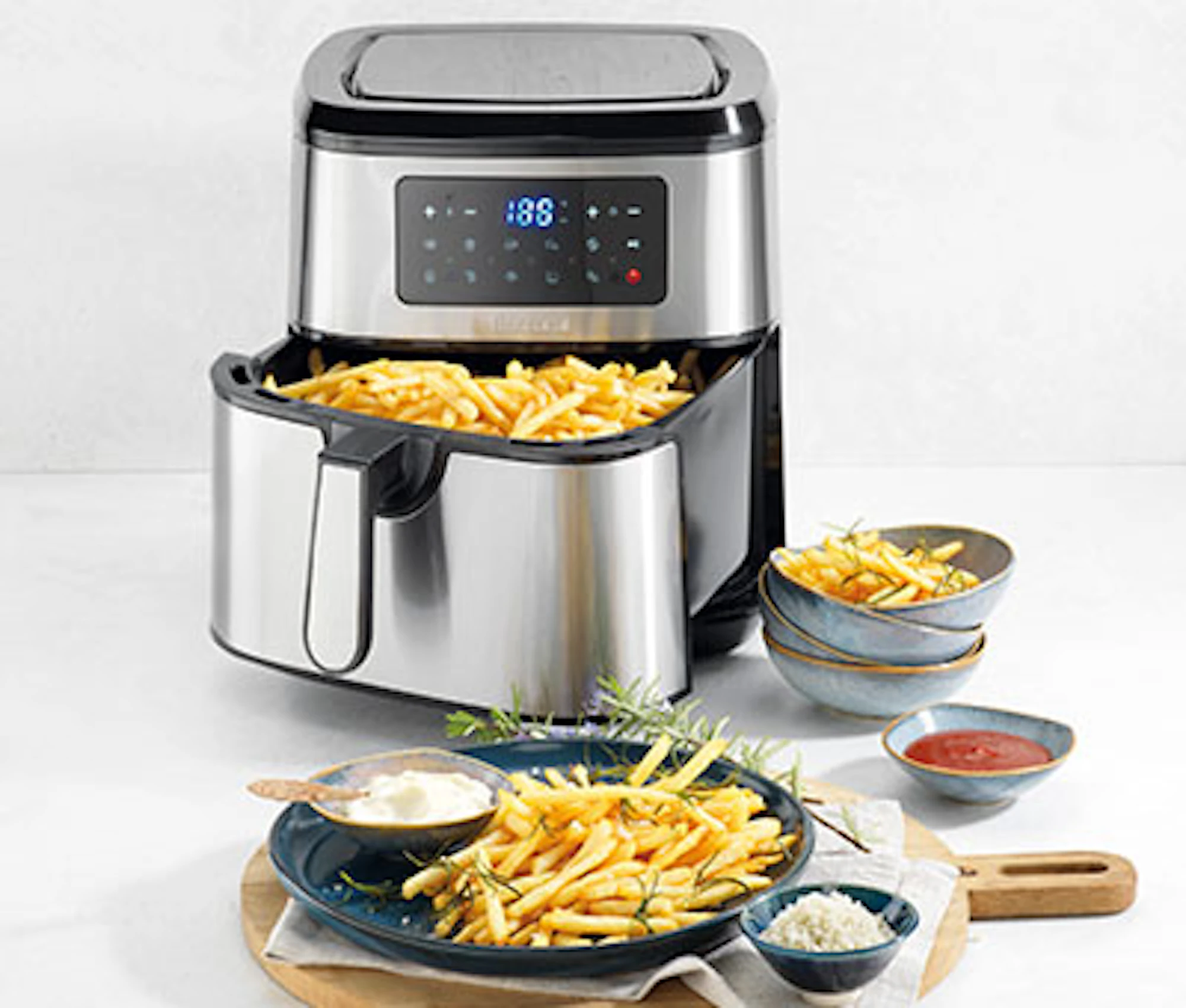
Current models at Robins Kitchen range from around 7L to 30L, with single-basket, dual-drawer and oven-style options.
A compact basket can make sense for smaller households, side dishes and reheating, while dual-drawer models let you cook two foods separately at the same time. Larger oven-style models provide more room for bigger batches and may include shelves or trays, but they also take up considerably more bench space. Think about what you normally cook before choosing capacity by litres alone.
What to check before buying an air fryer:
- Capacity against how many people you usually cook for
- Basket or oven style, and whether shelves and trays suit the food you make
- Whether the basket and other removable parts are dishwasher safe
- Preheat time and temperature range stated by the manufacturer
- Bench footprint and the clearance required above and behind the appliance
The right size is the one that handles your normal cooking without taking up more bench space than the convenience is worth.
Storing, carrying and keeping things fresh
Good storage helps you get more from the food you've already bought, while the right bottle makes drinks easier to take with you.
Food storage containers
Food storage containers turn leftovers into tomorrow's lunch rather than waste. Glass doesn't stain easily and may be microwave- or oven-safe when rated for it; plastic is lighter and usually cheaper but can stain; stainless steel is durable but can't go in the microwave.
If you mostly store leftovers at home, the extra weight of glass may not matter. If containers regularly travel to work or school, lighter plastic or stainless steel can be more practical. Also consider how you'll reheat the food. A container that's convenient for carrying isn't necessarily the one you'll want to put straight into the microwave.
Look for a set that stacks neatly and shares lid sizes. It saves cupboard space and makes matching containers and lids much easier.
Water bottles
An insulated stainless-steel bottle is useful when you need water to stay cold for hours. Double-wall vacuum insulation reduces heat transfer, and current insulated models at Robins Kitchen state cold-retention times ranging from 14 to 24 hours.
Also check that the opening is wide enough for ice, the lid is easy to use and clean, and the capacity is comfortable to carry. Check individual care instructions if dishwasher cleaning matters to you.
What changes when you spend more
A higher price should buy you something identifiable in the specifications. Rather than assuming expensive means better, compare what you're actually getting.
Here's what to check on any product page:
- Knives: Check steel type, Rockwell hardness where provided, and blade and handle construction.
- Cookware and utensils: Compare maximum heat or oven temperature and the stated cooking surface or coating.
- Appliances: Look at motor power alongside stated capabilities, capacity and dishwasher-safe parts. More watts alone don't necessarily mean better performance.
- Boards and timber: Check the timber and construction, such as end grain, edge grain or bamboo, plus care requirements.
- Everything: Read the warranty. Check its length, what it covers, and any conditions attached.
The useful question isn't "Which one is more expensive?" but "What specification changed?" A higher-priced knife might use a different steel or hold its edge longer. A pan may have a different construction or higher stated oven temperature. An appliance may offer more capacity, a function you'll actually use, or easier cleaning. If you can't identify a meaningful difference for the way you'll use the product, the cheaper option may be all you need.
Then consider frequency of use. A $100 tool used weekly for ten years costs about 19 cents per use. If it lasts where several cheaper replacements wouldn't, the higher upfront cost can represent better value.
A tool you use twice a year is a different decision. Paying more only makes sense when the additional durability, performance or features are useful to you.
The gadgets you can skip
A gadget earns its drawer space if it does something your existing tools can't do, or does a regular job significantly faster. Popular kitchenware isn't automatically useful kitchenware if you already own something that handles the same task.
Think twice about highly specialised gadgets such as avocado slicers, banana slicers, strawberry hullers or dedicated herb scissors. A chef's knife, small knife, peeler or kitchen scissors can already handle many of these jobs.
Some single-purpose tools do pass the test. A can opener does something your chef's knife shouldn't. A vegetable peeler removes thin strips of skin quickly with little waste, while a salad spinner dries a large batch of leaves far faster than patting them individually.
The test isn't how many jobs a tool can do. It's whether it solves a job you do often enough to make owning it worthwhile.
Start with the essentials in the checklist, then add specialised tools when a particular job keeps coming up.
How to make your kitchen tools last
Good maintenance extends the life of the kitchen tools you use most and improves their cost per use. Follow individual care instructions first, then use these basic habits:
- Hand-wash knives and timber boards rather than leaving them soaking, and dry them thoroughly before storing.
- Store knives separately in a knife block or magnetic holder so the blades aren't knocking against other utensils.
- Oil timber boards regularly with a food-grade board oil to help reduce water absorption, cracking and warping.
- Hone a knife regularly to realign its edge, then sharpen it when honing no longer restores a clean cut, rather than sharpening to a fixed timetable.
- Keep metal utensils away from non-stick cookware unless the manufacturer specifically states they're safe to use, as scratches can damage the cooking surface.
- Replace plastic chopping boards with deep scoring or grooves that have become difficult to clean properly.
Essential kitchen tools: your questions answered
What are the most essential kitchen tools?
The most essential kitchen tools are a chef's knife, chopping boards, tongs, a turner, mixing bowls, measuring cups and spoons, a vegetable peeler, colander and food storage containers. Start with tools for everyday cutting, cooking, measuring and storing, then add specialised equipment as you need it.
What's the one kitchen tool worth spending the most on?
A good chef's knife is usually worth investing more in because it handles so many everyday prep jobs. Look for comfortable balance, a secure grip, suitable steel and good edge retention rather than price alone. With proper care, a well-chosen knife can serve you for years.
How many chopping boards do I need?
Two chopping boards are a sensible minimum: one for raw meat, poultry and seafood, and another for foods eaten without further cooking. Keeping them separate reduces cross-contamination risk. Replace boards when deep grooves make them difficult to clean properly.
Do I need a blender and a food processor?
No, most kitchens don't need both unless you regularly use them for different jobs. Choose a blender for smoothies, drinks and liquid-heavy recipes, or a food processor for chopping, slicing and grating. Buy both if those two sets of tasks come up regularly.
What kitchen tools do I need for a first apartment?
For a first apartment, start with a chef's knife, two chopping boards, tongs, a turner, a mixing bowl, measuring tools, a peeler, a colander and food storage containers. Add appliances and specialised gadgets later. A smaller collection of useful kitchen necessities is better than filling limited cupboards with rarely used tools.
How often should I replace my kitchen tools?
Kitchen tools don't need replacing on a fixed schedule. Replace them when wear affects safety, hygiene or performance. Deeply scored chopping boards should go, while blunt knives can usually be sharpened rather than replaced. For appliances, cookware and utensils, follow the manufacturer's care guidance.
Back to blog